Cairns Real Estate Predictions 2027: Why the Outlook Still Looks Positive

Cairns property has already enjoyed substantial growth. The question for buyers now is whether there is still opportunity ahead, or whether the strongest gains are behind us.
My outlook for Cairns real estate in 2027 remains positive. Tight rental conditions, a constrained housing supply and investment in the city's economy give us sound reasons to remain optimistic.
However, another year of growth is a forecast, not a certainty. My base case is continued upward pressure on well-located, sensibly priced properties, with more variation between individual properties and market segments than a citywide headline can capture.
The September 2026 Cairns Economic Monitor, combined with the local agent discussions on Investment by Design, helps explain why.
Where is the Cairns property market now?
The September monitor reports the following figures. These are the latest available observations used in that edition, rather than measurements all taken in September.
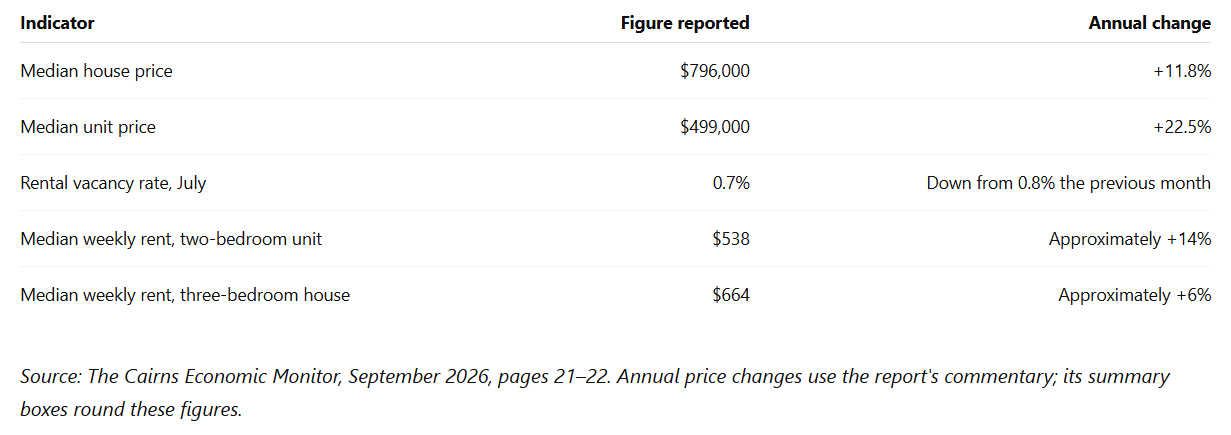
These numbers show a market entering the lead-up to 2027 with considerable momentum, particularly in units. They also show why it would be misleading to describe every part of Cairns as moving at the same speed: house-price growth has slowed, while annual unit-price growth has accelerated.
Past gains do not tell us exactly what happens next. To assess 2027, we need to look at what could sustain demand and how quickly additional housing can arrive.
1. Housing supply remains central to the outlook
The strongest argument supporting Cairns property is the difficulty of supplying enough housing.
According to the monitor, June's trend building approvals reached 101, recording their first monthly increase in ten months. That was encouraging, but the trend remained 21.2% below a year earlier.
There is an important qualification. A large Woree approval distorted that annual comparison. After adjusting for those units, the monitor puts the decline at a much smaller 2.3%.
Equally, actual approvals across the 2025–26 financial year rose 65.6%. We should acknowledge that improvement. The report explains, however, that exceptional apartment approvals in July 2025 accounted for much of the increase, rather than a sustained acceleration throughout the year.
The practical takeaway is that new housing is being approved, but the monitor still considers the underlying pace insufficient to materially address the accommodation shortage. Approvals also need to become completed homes before they relieve pressure on tenants and buyers.
In our local agent discussion, construction costs, access to trades and development feasibility were recurring concerns. Those are industry observations, rather than a precise measure of every project's viability, but they help explain why additional supply can take time.
My 2027 prediction: limited new supply should continue to support established property, provided buyer demand holds up. That support does not remove the possibility of price falls if borrowing conditions or confidence weaken.
2. A tight rental market supports the investment case
A rental vacancy rate of 0.7% is a strong indication of limited available accommodation. The monitor reports six consecutive months below 1%, following more than five years in which vacancy remained between 0.5% and 1.2%.
This gives the Cairns investment story substance beyond expectations of capital growth. There is evidence of an ongoing need for rental housing.
For 2027, I expect rental availability to remain an important support for the market unless completed supply rises substantially or demand softens.
However, rental shortages do not mean rents can rise indefinitely. Household incomes and affordability still matter. Nor does a strong advertised rent automatically produce positive cash flow. Insurance, body corporate levies, rates, maintenance, management and loan repayments can materially change the result.
The opportunity is to buy a property with sustainable tenant appeal and workable holding costs. Any future rental growth should strengthen an already sensible purchase.
3. Infrastructure provides reasons to look beyond tourism
Cairns' future is also tied to its role as a regional centre for health care, defence and aviation.
In my infrastructure discussion, I highlighted the hospital expansion, HMAS Cairns investment and airport development as projects to watch. Their potential relevance to property extends beyond construction activity: expanded services and operating capacity can support longer-term employment and accommodation demand.
The airport programme provides a concrete example. The Northern Australia Infrastructure Facility identifies upgrades to Cairns' international terminal, airside infrastructure and Eastern Aviation Precinct within its North Queensland Airports project. Its loan of up to $155 million covers both Cairns and Mackay airports, so that entire amount should not be attributed to Cairns. Source: NAIF, North Queensland Airports Upgrade Project.
The property-market implication is my analysis: a broader employment base can help sustain housing demand across more than one industry. Project timing and delivery still matter, and benefits will unfold over several years rather than all arriving in 2027.
Tourism also offers a positive, though mixed, signal. The September monitor reports international airport passenger trend growth of 10.8% over the year, while domestic passenger trends were unchanged. Total trend passenger growth was 1.6%.
That supports a story of improving international activity, without overstating it as a boom across the entire visitor economy.
4. Population growth supports the longer-term case
The population outlook in the monitor is more conservative than the projection discussed in my earlier video, so it is important to use the figures accurately.
The report cites the Queensland Government Statistician's Office medium projection for Cairns Regional Council: an increase from 181,418 to 218,181 people by 2046. That represents approximately 36,800 additional residents, or 20.3% growth.
This is a long-term projection, not a promise and not a forecast of growth during 2027 alone. It nevertheless supports the case for an ongoing need for homes, services and infrastructure.
The monitor also questions whether the projected slowdown in population growth is too conservative. That is the report author's assessment, rather than an alternative outcome we can assume will occur.
For property buyers, the useful question is how well a particular location and dwelling will serve that future population.
5. Which Cairns properties could perform well in 2027?
Our agent panel did not agree on everything, particularly the merits of houses versus apartments. That disagreement is useful: there is no single property type that suits every buyer.
Affordable apartments with manageable ownership costs remain an area I would watch. Their lower purchase prices can appeal to buyers priced out of houses. The monitor's strong unit-price growth supports that affordability theme, although repeating a 22.5% annual gain should not be an assumption. Building condition, body corporate finances and potential special levies deserve close attention.
Established houses with practical renovation potential were another recurring theme. The panel discussed opportunities in locations including Manoora, Manunda, Mooroobool and Bayview Heights. These are areas for investigation, rather than blanket suburb recommendations. The street, property condition, hazard exposure and purchase price can matter more than the suburb name.
Properties with genuine additional-dwelling potential may also interest buyers seeking both flexibility and rental income. But a large block alone does not establish feasibility. Planning requirements, servicing, access, construction costs and the completed value all need to work before any development upside is included in the purchase decision.
My preference is for opportunities that make sense at today's purchase price and costs, with a credible path to improvement.
What could change the positive outlook?
An honest prediction needs to acknowledge the evidence pointing towards a more measured market.
The monitor notes that annual house-price growth has slowed. In its sponsor commentary, a local selling agent also reports increased advertised listings and suggests houses may be approaching a period of stabilisation. That is an agent's market observation, not a confirmed citywide price decline, but it deserves attention alongside the positive statistics.
More listings can give buyers greater choice and reduce pressure to compete. Limited new construction and an increase in existing homes advertised for sale can occur at the same time.
Borrowing costs and affordability are other important variables. My positive outlook does not depend on interest-rate cuts arriving in 2027. If finance becomes more expensive or harder to obtain, demand could weaken even while rental accommodation remains scarce.
At the property level, flood and cyclone exposure, insurance costs and major building repairs can outweigh favourable market conditions. In Cairns, getting an insurance quote and understanding the specific property's risks should be part of assessing its value.
My Cairns real estate prediction for 2027
I remain optimistic about Cairns heading into 2027. The combination of tight rental availability, difficulty delivering sufficient housing, long-term population growth and investment in regional services gives that optimism an evidence-based foundation.
My base case is continued support for prices, with further growth possible in well-selected properties. I would also expect a more selective market, where affordability, condition and holding costs increasingly influence what buyers are willing to pay.
The available evidence does not support a reliable percentage forecast for 2027. A period of flatter house prices would not, by itself, erase the city's longer-term appeal.
For buyers, that can still be an encouraging environment. Opportunity does not require every property to rise rapidly. It requires finding the right property, paying a sensible price and having the capacity to hold it through changing conditions.
At The Buyers Co, we help owner-occupiers and investors assess Cairns and North Queensland property against their goals, local market evidence and the costs that matter. If you are planning a purchase in 2027, speak with The Buyers Co about building a strategy around your circumstances.
Source acknowledgement: Market, rental, approvals, tourism and population figures are drawn from The Cairns Economic Monitor, September 2026, published by Cairns Chamber of Commerce with data analysis and commentary by Pete Faulkner of Conus Business Consultancy Services. Relevant sections: pages 3–5, 9, 21–22, 25 and 28. Local industry perspectives are drawn from the two supplied Investment by Design video transcripts. Predictions and property-selection views are the author's opinions as at September 2026, not guaranteed outcomes.
