Cairns Property Market Update April 2026: Prices Rise, Supply Tightens, and Buyers Are Running Out of Time
Data sourced from Cairns Economic Monitor- https://www.cairnschamber.com.au/cairns-economic-monitor
If you’re wondering what the Cairns property market is doing right now, the April data tells a very clear story:
prices are still rising, vacancies remain tight, and new housing supply is not keeping up.
That matters because while plenty of buyers are waiting for more certainty around interest rates, the local market is still being driven by a structural shortage of accommodation, strong long-term demand, and a broader regional economy that continues to evolve beyond tourism alone.
For buyers and investors, that combination is important.
Because in Cairns, the question is no longer just “will rates affect buyer confidence?”
It is also “what happens when demand keeps rising but supply stays stuck?”
Cairns house prices and unit prices are still climbing
According to the April 2026 Cairns Economic Monitor, the median house price in Cairns is now $789,000, up 15% year-on-year, while the median unit price has reached $473,000, up 20% year-on-year. The report also notes that units have continued to outperform houses in recent months, with unit prices rising 5% since the earlier call that they may have more upside at this stage of the cycle, compared with a more modest 1.4% rise for houses.
That is a significant result when you consider the broader backdrop.
Interest rates have moved higher again, with the report noting the RBA lifted the cash rate to 4.1% in March, while futures markets were pricing in the possibility of further tightening through 2026. Yet despite that pressure, Cairns property values are still pushing higher.
That usually tells you something important:
this is not just a sentiment-driven market.
It is a market being supported by real supply constraints, affordability relative to larger cities, and a region that is still attracting people and capital.
Cairns remains one of Australia’s strongest-performing regional markets
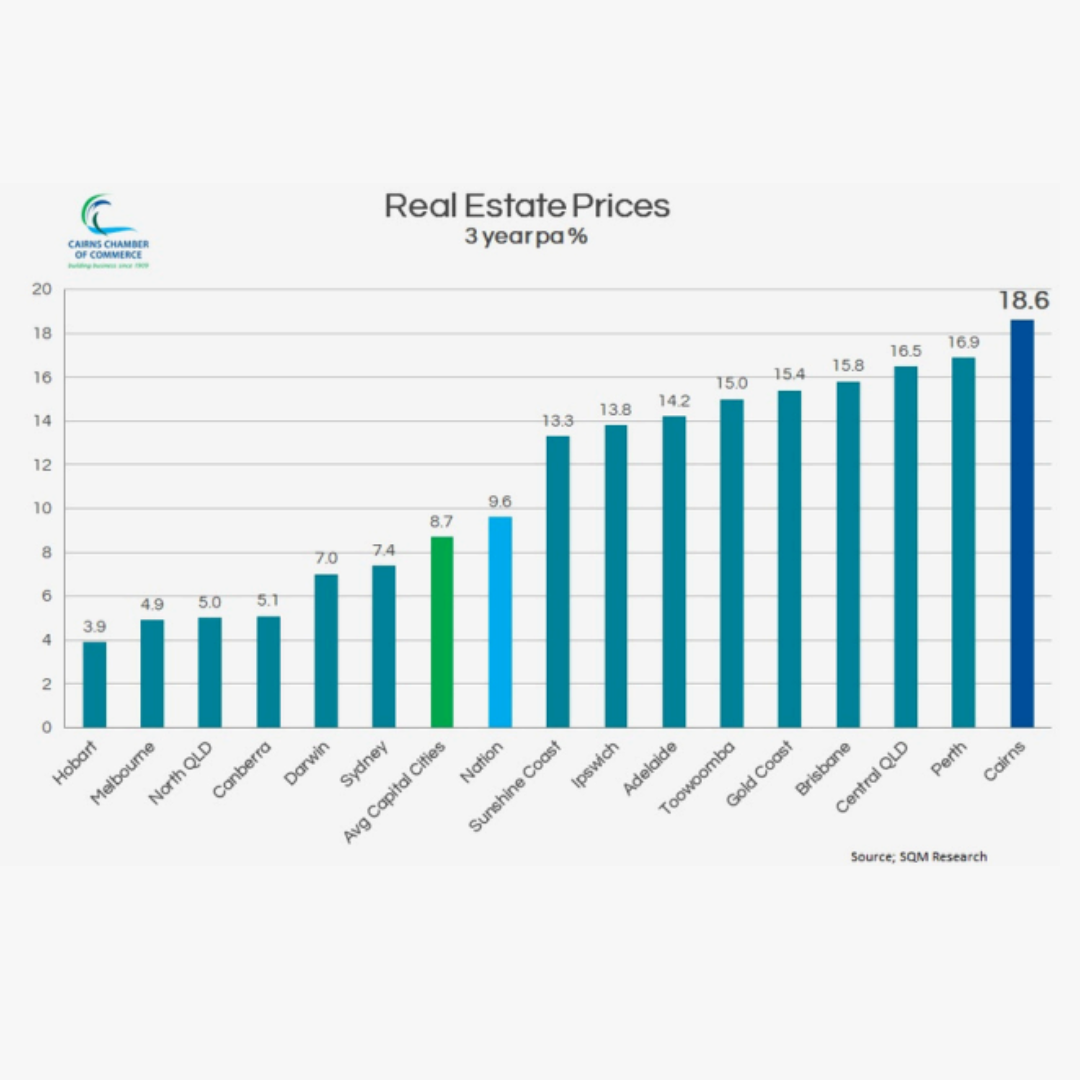
One of the standout numbers in the April report is Cairns’ three-year compounded annual growth rate of 18.6%, which the report says equates to a 67% increase over three years. It compares that with a national annual average of 9.6%, or 32% over three years. The same section notes that even after this outperformance, the median combined price in Cairns still sits $280,000 below the national average.
That matters for two reasons.
First, it shows Cairns has not just had a short-term spike. It has materially outperformed over a multi-year period.
Second, it suggests many buyers still see Cairns as a value market, not an exhausted one.
For owner-occupiers, that can mean getting into a city with improving fundamentals before affordability erodes further.
For investors, it means there is still a case for Cairns being a market where relative affordability and undersupply continue to support prices over time.
The real issue is not rates. It is supply.
If there is one theme that keeps showing up in the April report, it is this:
Cairns does not have enough new housing coming through.
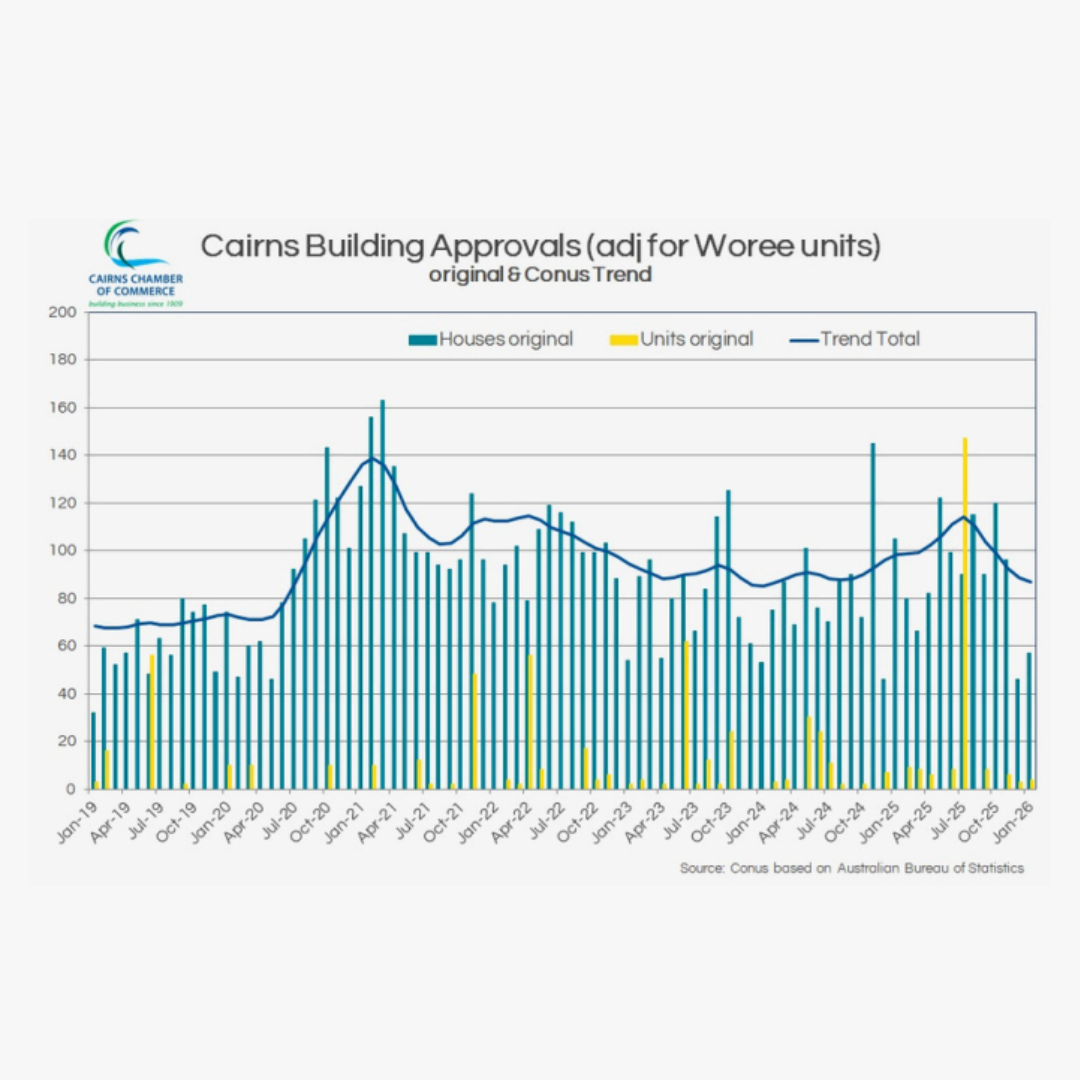
The report shows trend building approvals at 91 in January, down 8.3% year-on-year, and notes that when adjusted for the Woree affordable housing units, the trend is even weaker at 87 approvals. It goes on to say this adjusted figure is at its weakest level since early 2024, and before that, since mid-2020.
More importantly, the report makes the practical point buyers should care about:
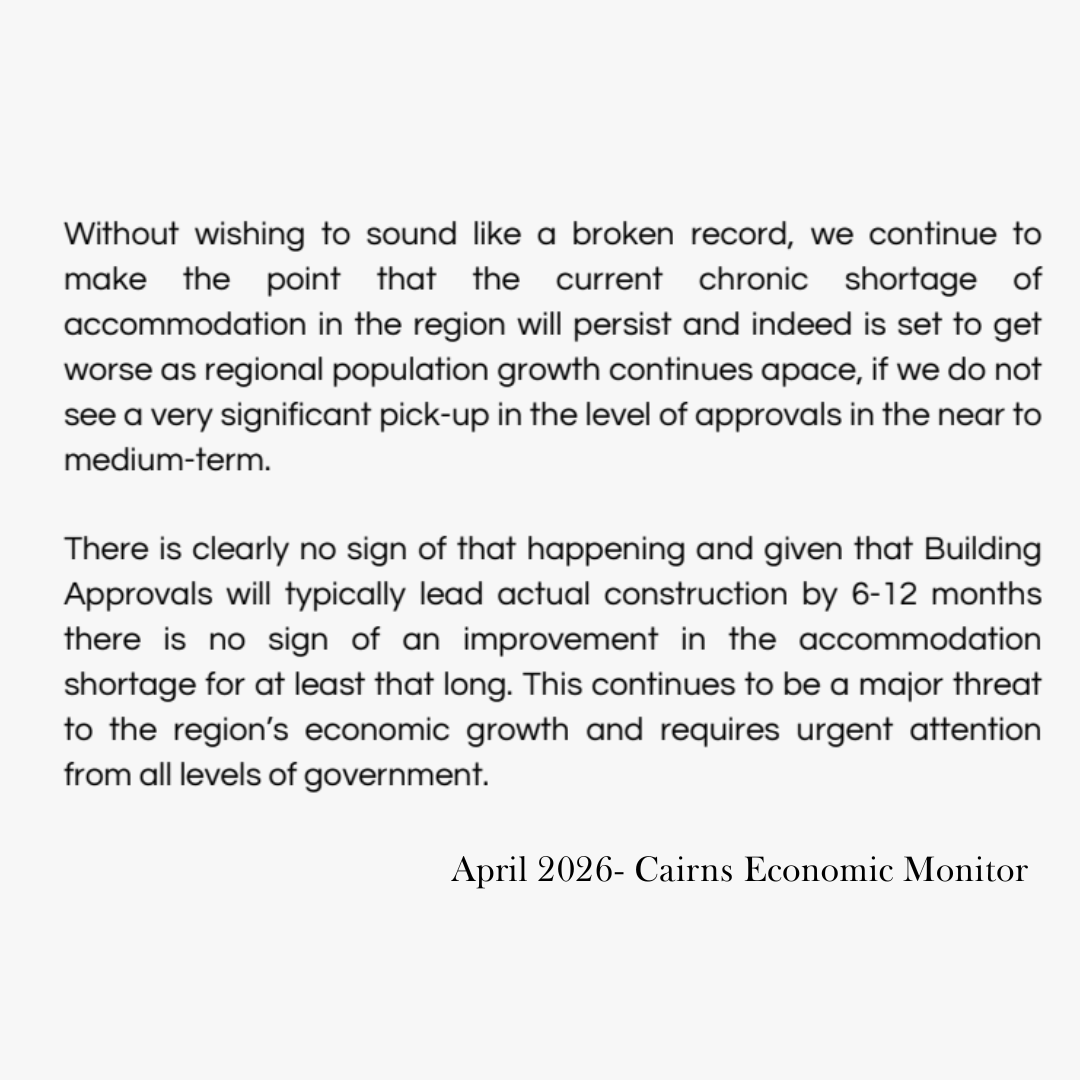
building approvals typically lead actual construction by 6 to 12 months, meaning there is no sign of an improvement in the accommodation shortage for at least that long.
That is the heart of the Cairns story.
When supply is not coming through fast enough, it keeps pressure on:
purchase prices
rental availability
tenant demand
competition for well-located stock
And in a city like Cairns, where geography already limits how easily the market can expand, that pressure becomes even more meaningful. Cairns Regional Council’s Towards 2050 strategy says the city is expected to add about 72,000 people by 2050, requiring substantially more housing over time.
Rental conditions are still tight in Cairns
The rental side of the market remains very firm.
The April report shows the vacancy rate at 1.0%, down from 1.1% the previous month. It also reports median rents of $508 per week for a 2-bedroom unit and $629 per week for a 3-bedroom house.
The report does note that rents have taken a slight breather recently, with houses up just 3% over the year and units barely changed in the latest period. But it also makes clear that the overall rental market remains tight, and that weakening building approvals are likely to keep that pressure in place.
That is an important nuance.
A short pause in rent growth does not necessarily mean the market has softened. In many cases, it simply means rents ran hard, paused, and are now being supported by the same underlying shortage that pushed them higher in the first place.
The Cairns economy is broader than many buyers realise
One of the biggest mistakes buyers make is assuming Cairns is still just a tourism town.
Tourism still matters, of course. But the broader regional story now includes healthcare, defence, logistics, education, and infrastructure-led employment. Your existing site has already been leaning into this theme, and rightly so.
There are three major pieces of context worth paying attention to.
The first is the Cairns Hospital expansion, with the Cairns and Hinterland Hospital and Health Service announcing a $1 billion expansion tied to a 30-year master plan.
The second is the HMAS Cairns upgrade, where Defence says a $250 million investment includes a new 212-metre wharf to support larger vessels and strengthen Navy capability in North Queensland.
The third is long-term population planning. Cairns Regional Council says the city is expected to grow by around 72,000 people by 2050, which reinforces the need for more housing, infrastructure, and services.
Taken together, those are the kinds of forces that can support housing demand well beyond a single property cycle.
What this means for buyers in 2026
For buyers, the Cairns market is becoming harder to navigate with broad suburb-level thinking alone.
When prices are rising, vacancies are tight, and good stock remains limited, small differences matter more:
street position
flood and insurance profile
body corporate set-up
surrounding housing quality
tenant appeal
future resale depth
That is why buyers in Cairns need to think beyond the headline market story.
Yes, the macro picture is strong.
But results still come down to buying the right asset in the right pocket at the right price.
In a market like this, the costliest mistakes usually are not dramatic. They are quieter:
buying in the wrong street, overpaying because of emotion, underestimating local risk, or choosing the wrong property type for your goals. That aligns closely with how your existing service and blog content position The Buyers Co: local, street-level advice, comparable-sales discipline, and end-to-end due diligence.
Is Cairns still a good place to buy property?
Based on the current data, the answer is yes, but only if you buy selectively.
The April report shows:
strong annual growth in both houses and units
a vacancy rate still sitting at just 1.0%
building approvals trending lower
a labour market that remains resilient
a region still backed by major infrastructure and long-term population growth
That is a strong combination.
But it does not mean every property in Cairns is a good buy.
It means the market tailwind is there.
The next step is making sure the individual property actually deserves to benefit from it.
Final thoughts
The April 2026 Cairns numbers reinforce what many local buyers are already feeling on the ground:
Cairns remains one of the tightest and strongest-performing regional property markets in Australia.
Prices are still rising.
Vacancy is still tight.
Supply is still not catching up.
And the broader city is continuing to strengthen underneath the market.
If you are researching the Cairns property market, trying to work out where to buy in Cairns, or deciding whether now is the right time to act, the biggest risk may not be that the market falls away.
It may be that you wait for perfect certainty in a market that is still being driven by structural undersupply.
Need help buying in Cairns with more clarity and less risk?
Speak with a local Cairns buyers agent who understands the market street by street, not just suburb by suburb.
