Cairns Real Estate Update — May 2026
Prices are still rising, supply is still tight, and the local economy is doing more heavy lifting than most buyers realise.
The Cairns property market is continuing to defy the easy headline narrative.
Interest rates are higher. Borrowing capacity has been squeezed. Buyers are more cautious than they were during the peak of the boom.
And yet, Cairns property prices are still moving.
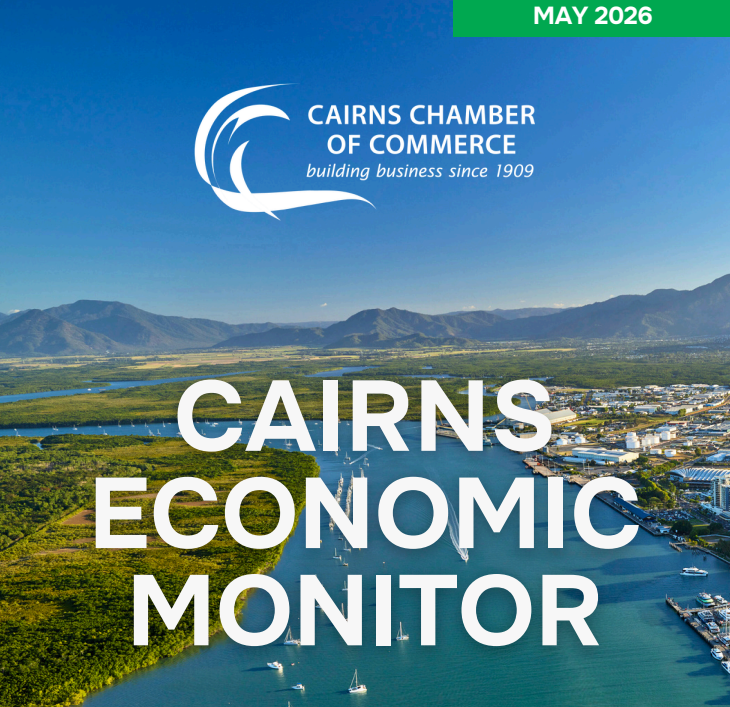
According to the May 2026 Cairns Economic Monitor, the median house price in Cairns has now reached $798,000, up 17.7% year-on-year, while the median unit price has climbed to $483,000, up 21.5% year-on-year. Over the past six months, units have outperformed houses, rising 14.5% compared with 6.2% for houses.
That tells us something important.
This market is not simply being driven by hype. It is being driven by a deep mismatch between demand, supply, affordability, infrastructure investment and rental pressure.
The biggest issue is still supply
The key number buyers should be watching is not just price growth.
It is building approvals.
The May report shows Cairns trend dwelling approvals have fallen to 88 approvals, down 18.6% year-on-year, the lowest monthly level since June 2024. While total approvals over the past 12 months look stronger on paper, much of that improvement came from unit approvals, including the large Woree project. More importantly, the report warns that monthly approvals have slowed sharply over the past four to five months.
That matters because building approvals are not houses. They are only the first step.
Even when a project is approved, it still needs finance, builders, feasibility, materials, labour and time. In a market where construction costs remain high and land is naturally constrained by mountains to the west and ocean to the east, new supply is not easy to deliver quickly. This is a point we have covered repeatedly at The Buyers Co: Cairns cannot simply sprawl in every direction like many other Australian cities. The city’s growth corridor is limited, and that makes well-located housing increasingly valuable over time.
The rental market remains extremely tight
Cairns’ rental vacancy rate has edged lower again to 0.9%.
The May Economic Monitor notes this is part of an extraordinary 63-month period where the vacancy rate has remained between 0.5% and 1.2%. That is not a normal rental market. That is a structurally tight rental market.
Median rents are now sitting around:
$500 per week for a two-bedroom unit
$651 per week for a three-bedroom house
Annual rental growth has moderated to around 5–6%, but the underlying shortage has not disappeared. In fact, if approvals continue slowing, there is very little evidence that rental pressure will be meaningfully solved in the short term.
For investors, this means yield still matters, but asset selection matters more than ever. Not every unit, townhouse or house is equal. Body corporate costs, flood overlays, insurance, maintenance, tenant demand, street quality and future resale demand all need to be assessed properly.
Units have had a massive run
One of the biggest shifts in Cairns over the past six months has been the strength of the unit market.
This is not surprising.
As houses push towards an $800,000 median, more buyers naturally start looking at townhouses, villas and apartments. First-home buyers, downsizers, investors and affordability-driven owner-occupiers all begin competing in the same lower-price segments.
That affordability squeeze is exactly why we have been talking about the sub-$500,000 market for months. Opportunities still exist in Cairns, but they are becoming harder to find, and the gap between “cheap” and “good value” is getting wider. The Buyers Co has previously highlighted that property under $500,000 is disappearing across Australia, but Cairns has still offered selected opportunities in city-fringe units and beachside apartments.
The mistake now would be assuming every unit is a bargain simply because it is cheaper than a house.
The better question is:
Is this property cheap for a reason, or is it genuinely mispriced?
The local economy is stronger than many people realise
The property market does not operate in isolation.
The Cairns labour market is showing real strength. Trend employment has reached an all-time high of 145,700 people, and the unemployment rate has fallen every month for the past six months to 4.2%. Cairns is the only Queensland region to record that level of improvement over recent months, according to the report.
Online job vacancies are also performing better than the Queensland and national averages, with Cairns job vacancies up 1.9% year-on-year, compared with 0.6% nationally and a 0.2% fall across Queensland.
This is important for property buyers because jobs support population retention, rental demand, household formation and confidence.
Cairns has long been viewed as a tourism-driven economy, but that is no longer the whole story. Health, education, aviation, defence, construction, professional services and infrastructure are all playing a larger role in the region’s long-term direction. That broader economic diversification is something we have covered through The Buyers Co and the Investment by Design podcast.
Tourism is mixed, but international recovery is helping
Tourism is still a major part of the Cairns economy, but the latest data is more nuanced.
The May Economic Monitor shows Cairns Airport passenger numbers were up 1.4% year-on-year in March on the original data, but the trend series has declined for five consecutive months and is now down 0.3% for the year. Domestic passenger numbers are weaker, down 5.6% year-on-year on the trend measure, while international passengers are up 8.2% and back near pre-COVID levels.
That matters because tourism supports jobs, business turnover, short-stay demand and investor confidence.
Cairns Airport is also undergoing important long-term upgrades, including a $55 million international terminal redevelopment, while the Eastern Aviation Precinct is expected to support tourism, mining, agriculture and defence, and create up to 400 full-time jobs.
Infrastructure remains a major long-term driver
Cairns is not just relying on population growth.
The region is seeing serious infrastructure investment.
The Cairns Hospital master plan includes a more than $1 billion expansion, with three new buildings planned as part of a broader health and innovation precinct. The Queensland Government has described it as the single biggest health investment ever for Cairns, with construction expected to be completed in 2031.
Defence is another major piece of the puzzle. The Federal Government announced a $250 million upgrade to HMAS Cairns, supporting Navy capability in North Queensland and reinforcing Cairns’ strategic importance.
These projects do not automatically mean every property goes up. But they do add weight to the bigger picture: Cairns is growing into a more mature regional capital, not just a tourism town.
Population growth is the long-term pressure point
The May report also highlights a critical population issue.
Cairns Regional Council’s estimated residential population grew by 1,761 people over the 2024–25 year to reach 179,334, a growth rate of 1.0%. That is slower than the post-COVID surge, but the longer-term average remains important. Since 2007, Cairns has averaged compound annual population growth of 1.5%.
The report makes a crucial point: if Cairns grows at 1.0% per year over the next 20 years, the population reaches roughly 218,822. But if it grows at the longer-term average of 1.5%, the population reaches around 241,537.
That is a difference of about 22,700 people.
Those people need homes, roads, schools, hospitals, water, sewerage and services. If planning is too conservative, the housing shortage becomes harder to solve.
What buyers should take from this
For buyers, the May update is clear.
Waiting for perfect conditions may feel safe, but in Cairns, the bigger risk may be waiting while the market keeps repricing around you.
That does not mean panic buying.
It means buying with a strategy.
The best opportunities are unlikely to be found by scrolling the same listings everyone else is watching. Buyers need to understand suburb-level demand, street quality, flood risk, body corporate costs, rental appeal, future resale depth and where affordability pressure is likely to push next.
Cairns still has opportunity, but the easy phase of the market is gone.
From here, the buyers who do well will not be the ones who simply buy anything.
They will be the ones who buy the right asset, in the right location, with the right due diligence, before the next wave of buyers works out what is happening.
The May data confirms what we have been saying for some time: Cairns is still being driven by supply shortage, rental pressure, infrastructure investment and long-term affordability compared with larger markets.
The window has not closed.
But it is getting narrower.
